

Germany Helium Market Grows with Industrial Demand; Linde, Air Liquide, Air Products Lead
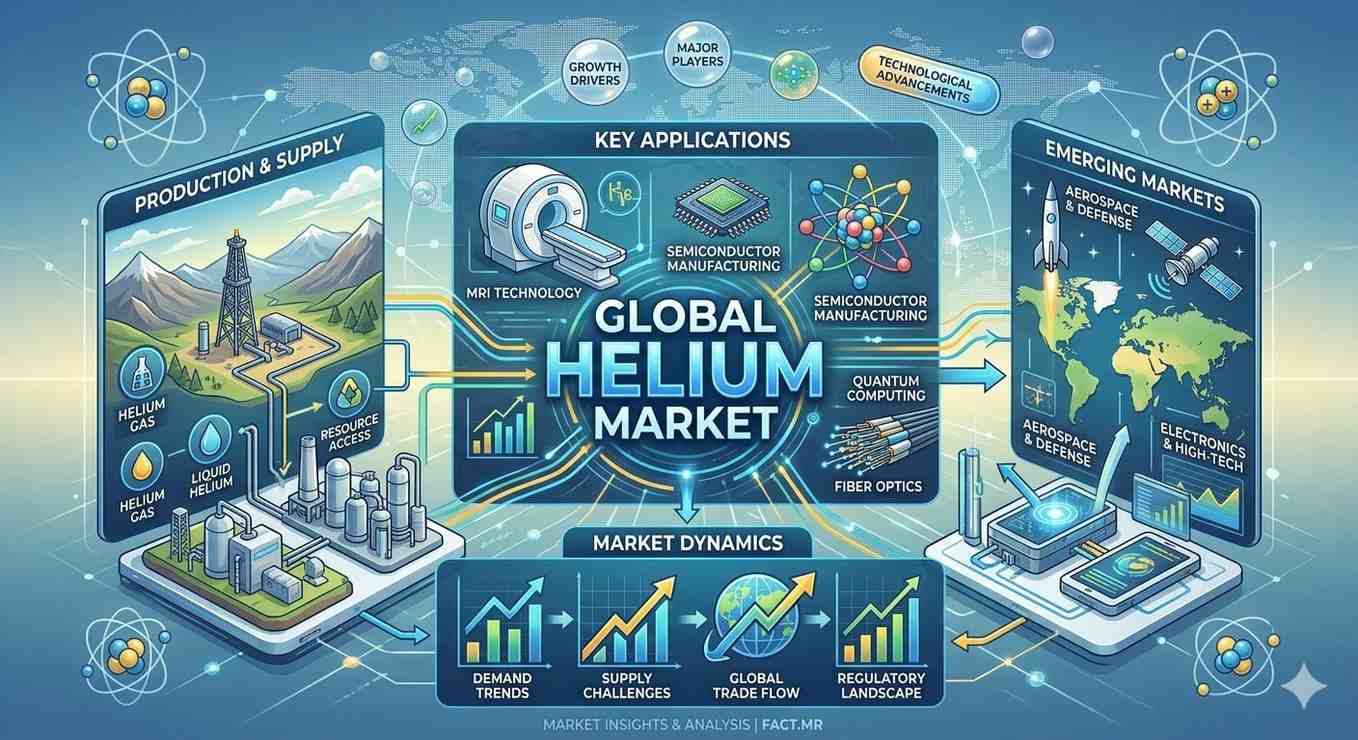
Helium Market
Rising semiconductor, healthcare, and aerospace demand drives Germany’s helium market growth
ROCKVILLE, MD, UNITED STATES, April 13, 2026 /EINPresswire.com/ -- According to Fact.MR’s latest analysis, the Germany helium market is part of a global industry valued at USD 4.40 billion in 2025, projected to reach USD 4.70 billion in 2026, and forecast to expand to USD 9.07 billion by 2036, registering a 6.80% CAGR.Germany itself is expected to grow at approximately 6.6% CAGR, driven by advanced manufacturing, healthcare infrastructure, and industrial gas distribution maturity. The market is set to create an incremental opportunity of USD 4.37 billion over the forecast period.
The transformation is anchored in supply-constrained dynamics, where access to helium reserves, liquefaction infrastructure, and long-term supply contracts determine competitive positioning—particularly across medical imaging, semiconductor fabrication, and aerospace applications.
Get detailed market forecasts, competitive benchmarking, and pricing trends:
https://www.factmr.com/connectus/sample?flag=S&rep_id=12073
Quick Stats
Market Size (2025): USD 4.40 Billion
Market Size (2026): USD 4.70 Billion
Forecast Value (2036): USD 9.07 Billion
CAGR (2026–2036): 6.80%
Incremental Opportunity: USD 4.37 Billion
Leading Segment: Gas Phase (72.0% share)
Leading Application: Cryogenics (23.0% share)
Leading Region in Europe: Germany (≈32.5% share)
Key Players: Linde Plc, Air Liquide, Air Products, Messer Group
Executive Insight for Decision Makers
Germany’s helium market is undergoing a strategic shift from commodity gas supply to high-purity, application-specific solutions.
OEMs & manufacturers must secure long-term supply contracts with purity guarantees.
Healthcare providers should adopt dual-sourcing strategies to avoid MRI downtime risks.
Semiconductor players need supply-chain-integrated procurement models aligned with fab expansion.
Failure to adapt exposes stakeholders to:
Supply disruptions
Production downtime
Significant financial losses (e.g., MRI quench events costing up to USD 1 million)
Market Dynamics
Key Growth Drivers
Expansion of MRI infrastructure across hospitals and diagnostic centers
Rising semiconductor fabrication at advanced nodes
Growth in aerospace testing and satellite programs
Demand for ultra-high purity gases in precision manufacturing
Key Restraints
Limited helium reserve concentration globally
High extraction and liquefaction costs
Increasing environmental and conservation regulations
Emerging Trends
Adoption of helium recovery and recycling systems
Shift toward ultra-high purity helium grades
Integration of closed-loop cryogenic systems
Long-term off-take contracts replacing spot procurement
Segment Analysis
Gas phase dominates with ~72% share due to ease of distribution and industrial versatility
Liquid helium holds ~28%, critical for MRI and aerospace cooling
By Application
Cryogenics (23%) – leading segment (MRI, superconductivity)
Leak detection – 18.4%
Welding – 14.7%
By End Use
Medical & Healthcare (~40%) – largest segment
Electronics & Electrical – 22.8%
Aerospace & Defense – 18.2%
Fastest-growing segment: Semiconductor-grade helium in electronics
Strategic Importance:
Cryogenics and semiconductor applications define long-term demand stability in Germany.
Supply Chain Analysis (Critical Insight)
Value Chain Structure
Raw Material Suppliers
Helium extracted as a by-product of natural gas processing (USA, Qatar, Russia)
Producers / Refiners
Global industrial gas companies purify and liquefy helium
Distributors
Cylinder gas suppliers, cryogenic tank logistics providers
Strong presence of integrated gas distribution networks in Germany
End Users
Hospitals (MRI systems)
Semiconductor fabs
Aerospace agencies
Industrial manufacturers
“Who Supplies Whom”
Global producers → German industrial gas distributors
Distributors → Hospitals, fabs, aerospace firms
Equipment manufacturers → Integrated supply contracts with gas providers
Key Insight:
Germany depends heavily on imported helium, making supply contracts and logistics infrastructure mission-critical.
Pricing Trends
Helium operates as a premium constrained commodity
Pricing varies by:
Purity level (industrial vs semiconductor-grade)
Form (gas vs liquid)
Contract structure (spot vs long-term)
Key Influencing Factors
Global supply availability
Energy and liquefaction costs
Transportation and storage
Certification requirements
Margin Insight:
Higher margins in ultra-high purity and medical-grade helium
Lower margins in bulk industrial gas supply contracts
Regional Analysis
Top Countries by CAGR
USA – 7.4%
China – 7.1%
India – 7.0%
Germany – 6.6%
Japan – 6.3%
Germany Growth Drivers
Advanced manufacturing ecosystem
Strong healthcare infrastructure
Mature industrial gas distribution networks
Developed vs Emerging Markets
Germany (Developed):
High purity demand
Stable consumption
Advanced infrastructure
Emerging Markets:
Higher growth rates
Infrastructure-driven demand
Increasing imports
Competitive Landscape
Market is moderately consolidated
Top 3 players control ~45–55% share
Key Players
Linde Plc
Air Liquide
Air Products and Chemicals, Inc.
Messer Group
Taiyo Nippon Sanso
Matheson Tri-Gas
Iwatani Corporation
Competitive Strategies
Long-term supply contracts
Expansion of distribution infrastructure
Investment in helium recovery technologies
Focus on high-purity gas solutions
Strategic Takeaways
For Manufacturers
Invest in helium efficiency and recovery systems
Secure multi-source supply agreements
For Investors
Focus on industrial gas infrastructure and logistics
Target semiconductor and healthcare demand hubs
For Marketers / Distributors
Emphasize supply reliability and purity certifications
Build long-term client relationships
Future Outlook
Germany’s helium market is moving toward:
Supply security-driven procurement models
Sustainability via recycling technologies
Integration with semiconductor and quantum computing ecosystems
Long-term opportunity:
High in ultra-high purity helium and cryogenic applications
Conclusion
Germany’s helium market stands at the intersection of industrial precision, healthcare expansion, and technological innovation. While supply constraints remain a structural challenge, they also create opportunities for companies that can deliver reliability, purity, and long-term contracts.
Why This Market Matters
Helium is not just an industrial gas—it is a critical enabler of modern healthcare, semiconductor innovation, and aerospace advancement.
For Germany, securing helium supply is directly linked to economic competitiveness, technological leadership, and healthcare resilience in the coming decade.
Full Report: Unlock 360° insights for strategic decision making and investment planning-
https://www.factmr.com/checkout/12073
To View Related Report:
Fermentation-Derived Bioplastic Building Block Intermediates Market https://www.factmr.com/report/fermentation-derived-bioplastic-building-block-intermediates-market
Carbon Coated Aluminum Foil Market https://www.factmr.com/report/carbon-coated-aluminum-foil-market
Anion Exchange Membrane (AEM) Ionomers Market https://www.factmr.com/report/anion-exchange-membrane-aem-ionomers-market
Steel Scrap Market https://www.factmr.com/report/steel-scrap-market
S. N. Jha
Fact.MR
+1 628-251-1583
email us here
Legal Disclaimer:
EIN Presswire provides this news content "as is" without warranty of any kind. We do not accept any responsibility or liability for the accuracy, content, images, videos, licenses, completeness, legality, or reliability of the information contained in this article. If you have any complaints or copyright issues related to this article, kindly contact the author above.
