

Germany Bio-Based Malonic Acid Esters Market Expands Under EU Green Push; BASF, Cargill Lead
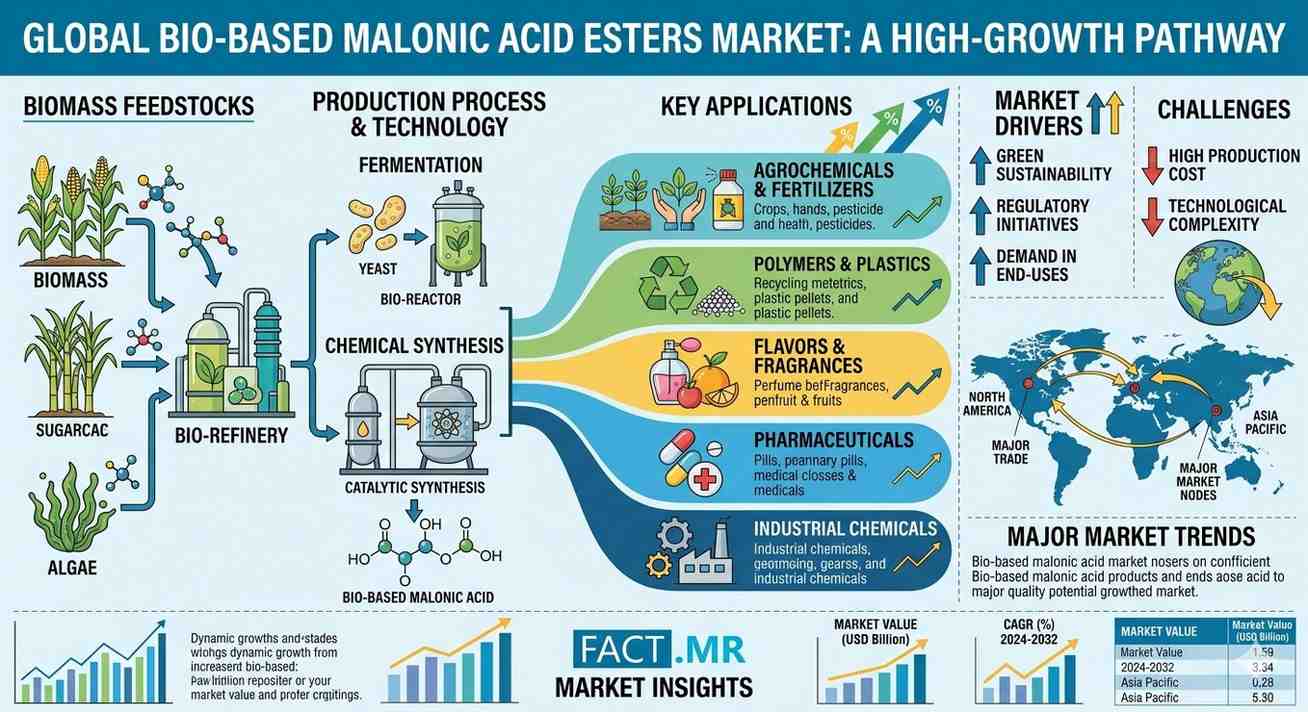
Bio-based Malonic Acid Esters Market
EU sustainability mandates and pharma demand accelerate bio-based chemical adoption in Germany
ROCKVILLE, MD, UNITED STATES, April 13, 2026 /EINPresswire.com/ -- According to Fact.MR’s latest analysis, the Germany bio-based malonic acid esters market is part of a global industry valued at USD 11.5 billion in 2025, projected to reach USD 12.4 billion in 2026, and forecast to grow to USD 27.6 billion by 2036, expanding at a CAGR of 8.3%.Germany is expected to grow at approximately 8.0% CAGR, driven by regulatory-led demand and pharmaceutical sector expansion. The market is set to create an incremental opportunity of USD 15.2 billion over the forecast period.
The market is undergoing a structural shift from petrochemical-based intermediates to certified bio-based alternatives, driven by EU sustainability mandates and increasing procurement requirements for traceable, low-carbon inputs.
Get detailed market forecasts, competitive benchmarking, and pricing trends:
https://www.factmr.com/connectus/sample?flag=S&rep_id=14695
Quick Stats
Market Size (2025): USD 11.5 Billion
Market Size (2026): USD 12.4 Billion
Forecast Value (2036): USD 27.6 Billion
CAGR (2026–2036): 8.3%
Incremental Opportunity: USD 15.2 Billion
Leading Product: Diethyl Malonate (38% share)
Leading Feedstock: Sugarcane (40% share)
Leading Application: Pharmaceuticals (45% share)
Key Players: BASF, Cargill, Mitsubishi Chemical, Novozymes, Genomatica
Executive Insight for Decision Makers
Germany’s market is shifting from cost-driven sourcing to compliance-driven procurement, where bio-origin certification is becoming mandatory.
Manufacturers must invest in bio-based production with full traceability
Pharma companies need dual sourcing with certified suppliers
Investors should focus on integrated bio-feedstock and fermentation platforms
Risks of not adapting:
Loss of regulatory compliance under EU frameworks
Exclusion from pharmaceutical supply chains
Reduced pricing power in premium segments
Market Dynamics
Key Growth Drivers
Strong demand for bio-based pharmaceutical intermediates
EU Green Deal pushing chemical substitution mandates
Expansion of agrochemical and specialty chemical applications
Rising adoption of bio-based polymers and flavour compounds
Key Restraints
Higher production costs vs petrochemical alternatives
Limited processing infrastructure in Europe
Complexity of chain-of-custody certification
Emerging Trends
Premium pricing for certified bio-based inputs (15–30%)
Growth in fermentation-based chemical production
Increasing demand for traceability and ESG compliance
Supplier consolidation toward qualified bio-based producers
Segment Analysis
By Product Type
Diethyl malonate leads (38%) due to its critical role in API synthesis
Dimethyl and specialty esters gaining traction in niche applications
By Source
Sugarcane dominates (40%) due to high yield and cost efficiency
Corn and biomass residues emerging as alternatives
By Application
Pharmaceuticals (45%) – dominant segment
Agrochemicals – second largest
Polymers & flavours – emerging growth areas
Fastest-growing segment: Bio-based esters for pharmaceutical APIs
Strategic Importance:
Pharmaceutical applications anchor long-term demand stability and premium pricing.
Supply Chain Analysis (Critical Insight)
Value Chain Structure
Raw Material Suppliers
Sugarcane, corn, cassava, biomass residues (Brazil, India, U.S.)
Fermentation & Chemical Producers
Convert biomass into malonic acid and ester derivatives
Specialty Chemical Manufacturers
Produce high-purity esters for pharma and agrochemical use
Distributors
Specialty chemical distributors across Europe
End Users
Pharmaceutical companies
Agrochemical manufacturers
Polymer and flavour producers
“Who Supplies Whom”
Global feedstock producers → fermentation companies
Producers → specialty chemical manufacturers
Manufacturers → pharmaceutical & agrochemical firms
Key Insight:
Germany relies on imported bio-feedstock but leads in high-value processing and certification-driven distribution.
Pricing Trends
Market operates as a premium specialty chemical segment
Bio-based esters command 15–30% price premium
Key Influencing Factors
Feedstock cost and availability
Certification and traceability requirements
Purity specifications for pharmaceutical use
Margin Insight:
Higher margins for pharma-grade certified esters
Lower margins for bulk industrial applications
Regional Analysis
Top Countries by CAGR
China – 9.5%
India – 9.2%
United States – 8.8%
Germany – 8.0%
Japan – 7.2%
Germany Growth Drivers
Strong pharmaceutical manufacturing base
Strict EU sustainability regulations
Demand for certified bio-based intermediates
Developed vs Emerging Markets
Germany (Developed):
Compliance-driven demand
High purity and certification focus
Premium pricing environment
Emerging Markets:
Feedstock-driven production
Cost competitiveness
Rapid capacity expansion
Competitive Landscape
Market is fragmented in production but consolidated in qualified supply
Key Players
BASF
Mitsubishi Chemical Corporation
Cargill
Novozymes
Genomatica
Myriant Corporation
BioAmber
Competitive Strategies
Investment in bio-based fermentation technologies
Expansion of certified production capacity
Vertical integration into feedstock supply chains
Long-term contracts with pharmaceutical buyers
Strategic Takeaways
For Manufacturers
Build traceable, certified bio-based supply chains
Invest in fermentation and process efficiency
For Investors
Target bio-based chemical platforms and feedstock integration
Focus on EU-compliant production facilities
For Marketers / Distributors
Emphasize sustainability credentials and certification
Strengthen relationships with pharmaceutical clients
Future Outlook
Germany’s market is moving toward:
Full integration of bio-based chemistry in pharma supply chains
Expansion of low-carbon chemical production
Increased reliance on certified, traceable intermediates
Long-term opportunity:
High in pharmaceutical APIs and specialty sustainable chemicals
Conclusion
Germany’s bio-based malonic acid esters market is transitioning into a compliance-driven, high-value specialty chemical segment. Companies that align with EU regulations, certification standards, and sustainable production models will secure long-term competitive advantage.
Why This Market Matters
Bio-based malonic acid esters are emerging as critical building blocks for sustainable pharmaceuticals, agrochemicals, and advanced materials.
For Germany, this market represents a strategic pathway toward green chemistry leadership, regulatory compliance, and high-value industrial growth.
Full Report: Unlock 360° insights for strategic decision making and investment planning-
https://www.factmr.com/checkout/14695
To View Related Report:
Bio-Based Acetic Acid Market https://www.factmr.com/report/1189/bio-based-acetic-acid-market
Bio-Based Acetic Acid Industry Analysis in the UK https://www.factmr.com/report/united-kingdom-bio-based-acetic-acid-industry-analysis
USA Bio-Based Acetic Acid Industry Analysis https://www.factmr.com/report/usa-bio-based-acetic-acid-industry-analysis
Biobased Thermosetting Polymers Market https://www.factmr.com/report/5386/biobased-thermosetting-polymers-market
S. N. Jha
Fact.MR
+1 628-251-1583
email us here
Legal Disclaimer:
EIN Presswire provides this news content "as is" without warranty of any kind. We do not accept any responsibility or liability for the accuracy, content, images, videos, licenses, completeness, legality, or reliability of the information contained in this article. If you have any complaints or copyright issues related to this article, kindly contact the author above.
